


 Cart
Cart
 sales@molnova.com


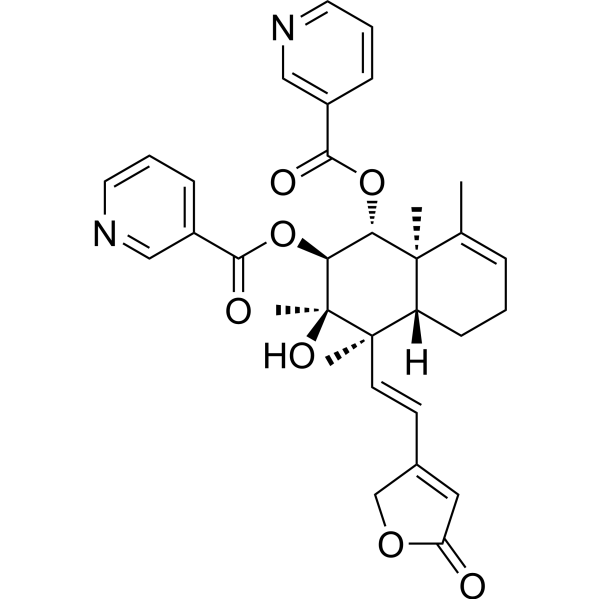
Scutebarbatine A
CAS No. 176520-13-1
Scutebarbatine A( —— )
Catalog No. M30883 CAS No. 176520-13-1
Scutebarbatine A shows significant antitumor effects on A549 cells in vivo and in vitro via mitochondria-mediated apoptosis by up-regulating expressions of caspase-3 and 9, and down-regulating Bcl-2.
Purity : >98% (HPLC)
 COA
Datasheet
HNMR
HPLC
MSDS
Handing Instructions
COA
Datasheet
HNMR
HPLC
MSDS
Handing Instructions
| Size | Price / USD | Stock | Quantity |
| 5MG | 873 | In Stock |


|
| 50MG | Get Quote | In Stock |
|
| 100MG | Get Quote | In Stock |
|
Biological Information
-
Product NameScutebarbatine A
-
NoteResearch use only, not for human use.
-
Brief DescriptionScutebarbatine A shows significant antitumor effects on A549 cells in vivo and in vitro via mitochondria-mediated apoptosis by up-regulating expressions of caspase-3 and 9, and down-regulating Bcl-2.
-
DescriptionScutebarbatine A shows significant antitumor effects on A549 cells in vivo and in vitro via mitochondria-mediated apoptosis by up-regulating expressions of caspase-3 and 9, and down-regulating Bcl-2. Scutebarbatine A and barbatine A show a significant ability to protect cells against H2O2 with ED50 values of 5.0 and 16.8 μM, respectively.
-
In Vitro——
-
In Vivo——
-
Synonyms——
-
PathwayOthers
-
TargetOther Targets
-
Recptor——
-
Research Area——
-
Indication——
Chemical Information
-
CAS Number176520-13-1
-
Formula Weight558.6
-
Molecular FormulaC32H34N2O7
-
Purity>98% (HPLC)
-
Solubility——
-
SMILES——
-
Chemical Name——
Shipping & Storage Information
-
Storage(-20℃)
-
ShippingWith Ice Pack
-
Stability≥ 2 years
Reference
molnova catalog



related products
-
Fmoc-Ile-OH
Fmoc-Ile-OH (Fmoc-L-isoleucine) is an Fmoc-modified isoleucine with a strong affinity for peptides and proteins and can be used to synthesize other active compounds.
-
Mezlocillin Sodium
Mezlocillin sodium is a penicillin beta-lactam antibiotic used in the treatment of bacterial infections caused by susceptible, usually gram-positive, organisms.
-
Lumiflavine
Lumiflavine inhibits riboflavin uptake. It is produced by the photolysis of vitamin B2.
